Showing posts with label read-along. Show all posts

Wednesday, August 1, 2012

The Moonstone BEGINS, with forehead-sized expectations


It's AUGUST already. I can't . . . I don't even know how that happened.

But August brings with it another Reading Rambo read-along (I use a hyphen here even though no one else seems to. Sing-along has a hyphen, doesn't it? *consults dictionary* Oh NO. It's singalong WITHOUT A HYPHEN. But readalong isn't a word! This is not a good start.).

For most of us, Alice's last read-along readalong? read-along was our first encounter with one Wilkie "The Forehead" Collins.

Close enough

Generally, all the introduction posts for The Woman in White were variations on, "The Internet informs me that Wilkie Collins was bosom friends with Charles 'Douche-Canary' Dickens."


But then Wilkie took us gently by the hand and led us on a winding journey of mystery and intrigue, and gave us Pesca ("deuce-what-the-deuce!") and Fosco (aka The Fat Man) and Marian (Mariaaaaaaaaan!). And by the end, we were ALL devout followers of the Wilkster.

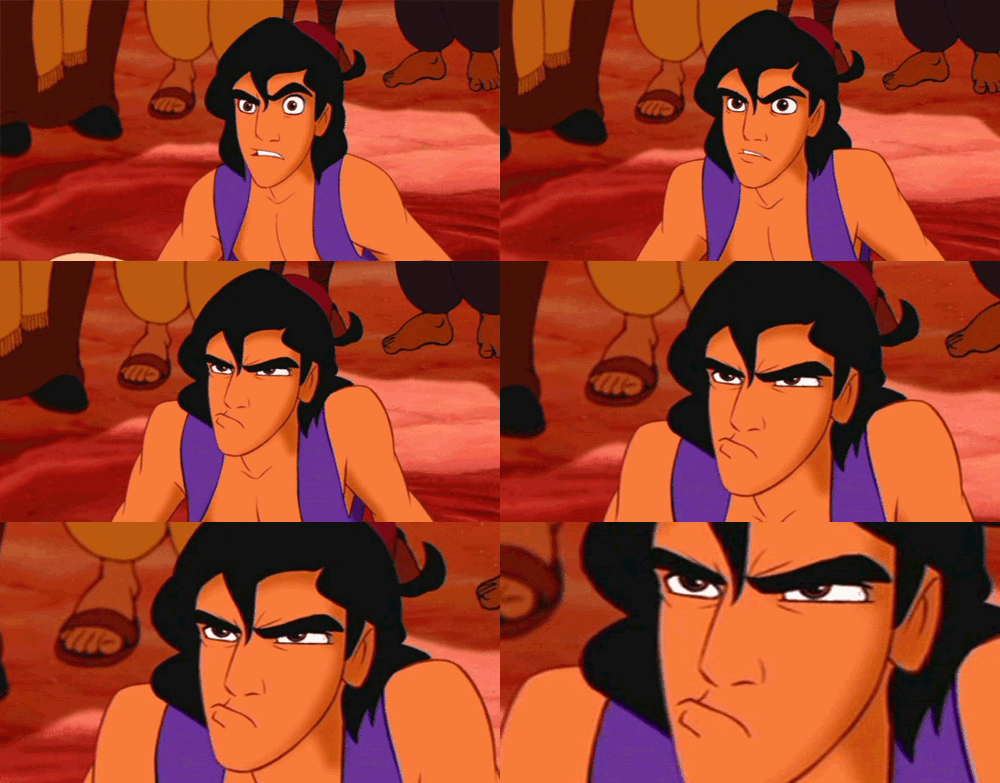
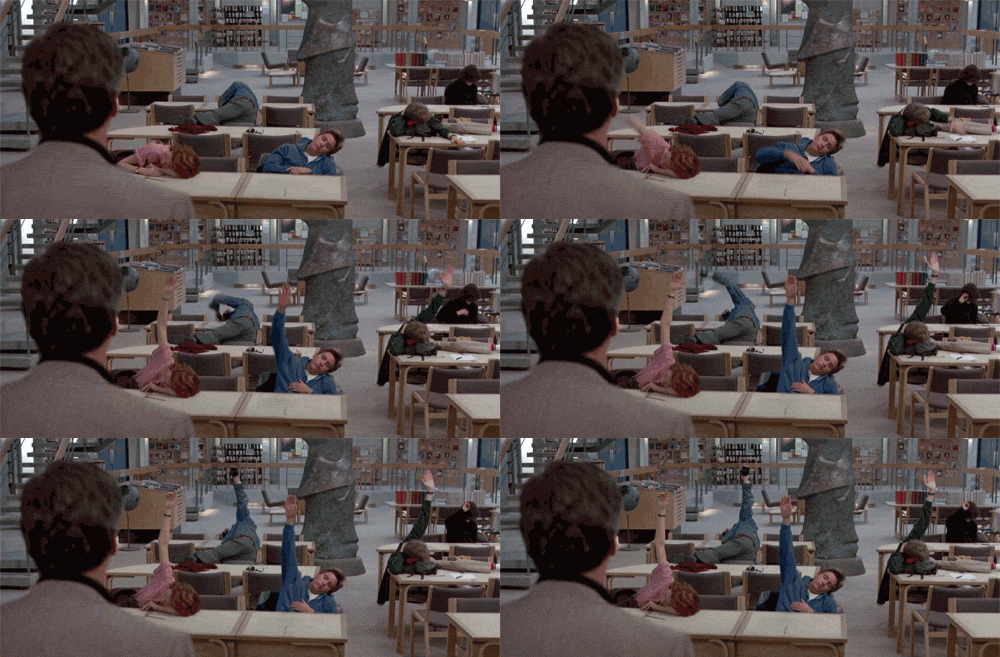
Fast-forward to Laura reading Armadale (WITHOUT US) and telling us how amazing it was, triggering our collective yearning for more Group Time with Wilkie. Then when Alice said, LET'S READ MORE WILKIE, we were like . . . 


And that's what's happening. We're reading The Moonstone. And I have no idea what it's about or if there will be ghosts or men in turbans or, as my book cover suggests, an ordinary room with absolutely no one in it. And I don't particularly care, because it's going to be AMAZING.

But seriously . . . is someone hiding in the curtains?

Tuesday, May 1, 2012

Woman in White Week 4: Blah blah blah...PESCA!


**DISCLAIMER: This post is part of a read-along, and I intend to ruin the entire plot in the most roundabout way possible.**

By some terrible/wonderful coincidence, the end of our read-along exactly coincided with the monster deadline that’s been plaguing me all month. I present to you my excuse for this post happening in *GASP* MAY. I guess this means I won’t get any cake at our end-of-read-along pizza party.

I found this last section to be pretty unspectacular, because it seemed to reiterate a lot of the things we already knew and/or had figured out with our powers of deduction and plot prediction.


My reading went thusly:

Oh, hello, world’s longest letter from Mrs. Catherick, in which she creepily flirts with Walter. Boring boring boring. She appears to like presents. Yep, she traded her own daughter for a gold watch and chain. Boring boring. Percival’s parents weren’t married to each other. Yes, yes, Catherick, we knew that. Get on with it. Boring. Anne never actually knew the Secret that basically claimed her life. Poor Anne. Boring boring. Mrs. Catherick protests too much about the question of Anne’s parentage. (Surprise! Mr. Fairlie was her father! Anne and Laura were half-sisters! WE WERE RIGHT ALL ALONG.) Mrs. Catherick issues the best invitation to tea that I have ever heard.
“My hour for tea is half-past five, and my buttered toast waits for nobody.” (p. 673)
Walter divulges that he’s been telling the story using feigned names THIS WHOLE TIME. I feel betrayed, Walter . . . or, whatever your name is.

Fosco has the opportunity to expose Laura’s hiding place to the owner of the asylum but changes his mind at the last moment because his devotion to Marian will not allow him to cause her such suffering. Marian is not flattered.
“No words can say how degraded I feel in my own estimation when I think of it—but the one weak point in that man’s iron character is the horrible admiration he feels for me.” (p. 683)
Then Walter sums up our feelings about Fosco’s villainy, and also what makes him such a wonderfully complex character.
“The best men are not consistent in good—why should the worst men be consistent in evil?” (p. 683)
Then Walter waxes sentimental.
“There (I said in my own heart)—there, if ever I have the power to will it, all that is mortal of her shall remain, and share the grave-bed with the loved friend of her childhood, with the dear remembrance of her life. That rest shall be sacred—that companionship always undisturbed!” (p. 693)
Then Walter and Laura, predictably, are wed.

And THEN, my dear friends, this lackluster section was lackluster no longer.

PESCAAAAAAAAAAAAAAAAA!!!!!!!!!

I have never been so happy in my LIFE for a character’s return. And even though we’ve heard no mention of Pesca since the earliest pages of the book, it turns out he's been a true and faithful friend to Walter all along, but it just didn’t happen to be relevant to the Big Mystery so we didn’t get to hear anything about it. I take back every nice thing I ever said about Walter.

Anyway, they go to the opera to see if Pesca recognizes Fosco, because all Italians know each other, apparently. (Did anyone else read that sentence about Fosco occupying a place 12 or 14 seats from the end of the bench and picture Fosco literally occupying 12 or 14 seats?) Pesca declares, in Pesca fashion, “I have never set my two eyes on that big fat man before, in all my life” (p. 713). But when the Fat Man sees Pesca (who, might I remind you, is so tiny that he had to get a boost so he could see over the heads of ladies who were SITTING DOWN), his enviably unflappable nerves are decidedly flapped.


And HOW does our delightful little Pesca strike terror into the heart of the great and powerful Fosco? Well, because Pesca is at the top of a secret Brotherhood, and Fosco is scheduled to be assassinated any day now for betraying the oath of that Brotherhood. HOLY TINY ITALIAN ASSASSIN. My heart, it swells.

And then we have the big confrontation between Fosco and Walter, to which, thank goodness, Walter remembered to bring his brain. Fosco agrees, under threat of exposure to the Brotherhood, to write his confession of the Great Switcheroo. There aren’t too many grand revelations in his confession, but he does show once and for all how creepily fond he is of Marian. Like, dirty-old-man levels of fondness. Also, he reveals that he actually WAS trying to help Marian get better when she was sick and the doctor attending to her actually WAS an idiot. And he wants us to know, also, that Anne died most inconveniently of natural causes . . . but if she hadn’t, he would have killed her probably the next day. Admirable. And off he toddles to Paris to be tossed in the river by someone in the Brotherhood who isn’t Pesca.

I was somewhat bothered by the fact that Marian vowed never to leave Laura and Walter. I suspect Wilkie is making some sort of statement here about how Marian doesn’t need a husband to be happy, but I don’t like the idea of her being the eternal third wheel. She deserves better than that.

But other than Marian, who will be providing Walter and Laura free babysitting for the rest of her days, everyone lives happily ever after in Limmeridge House because Mr. Fairlie's nerves finally killed him.

And now, we dance the dance of the victorious read-alongers!


Monday, April 23, 2012

Woman in White Week 3: The Great Chicanery


**DISCLAIMER: This post is part of a read-along, and I intend to ruin the entire plot in the most roundabout way possible.**

What I didn't talk about last week even though I was DYING to was Marian getting sick and the Fat Man INVADING her diary with his fat hands and his ho-ho-hum, you clever woman, you. And all her plans! Foiled by the curse of a delicate female constitution!

Then, FINALLY, we get to hear Mr. Fairlie's opinion on the whole matter. Why can't anyone ever leave him alone so he can polish his coins and photograph his art collection? Even the clumsy English language is set against him. And then here comes Laura's maid and her potentially squeaky shoes. IS THERE NO END TO THE IRRITATIONS HE MUST ENDURE?

And I basically underlined everything he said, because---yes, I'm really about to say this---I liked his section more than Marian's. Can we just reread his narrative out loud via group conference call? No? Fine, but I'm making you reread these two parts, because I admire his use of parenthetical statements.
"Miss Halcombe had come to say good-by, and had given her two letters, one for me, and one for a gentleman in London. (I am not the gentleman in London---hang the gentleman in London!) She had carefully put the two letters into her bosom (what have I to do with her bosom?)" (p. 419)
"(Am I responsible for any of these vulgar fluctuations, which begin with unhappiness and end with tea?)" (p. 419)
Basically, what we learn from this section is that the Countess went to the inn and DRUGGED Fanny and groped under her dress to steal Marian's letter to the attorney. You know things are serious when people are being drugged and felt up. Team Percival just stepped up their game, yo.

The other thing we learn is that Mr. Fairlie is not impressed by Fosco (he is immune to the Fat Man's charms), but he does admire his seeming lack of nerves. Personally, I think Fosco HAS nerves, but all the fat is insulating them from shock. Oh, and the OTHER thing we learned from Mr. Fairlie is that Louis, his valet, is a god among men. Seriously, Louis, I salute you.

Then Mrs. Michelson describes what I like to call "The Great Chicanery," in which Fosco and Percival HIDE OUR DEAR SWEET FEVERISH MARIAN from Laura so they can convince Laura to go to London in search of her.

And I can't quite figure out Mrs. Rubelle's motives in all this, but she gives me the heebies and the jeebies.

Much like this overzealous Ewok.

BUT YOU GUYS, our woman in white is dead! This is what we get for demanding a ghost. Poor Anne, come face-to-face with her nemesis at last . . . and it was too much for her poor heart to bear. That makes me sad. Let's not think about that anymore. BUT because everyone thinks she's Laura, she gets her one wish, which is to be buried next to her beloved Mrs. Fairlie.

Was anyone else kind of impressed by Walter's newfound bad-assitude? He survived disease and Indians in Central America and a shipwreck in the Gulf of Mexico. But he can still weep into his mommy's bosom when he hears the news of Laura's death. That's my kind of man.

When Walter runs into Marian and Laura in the graveyard, Marian's first instinct is to protect him. She doesn't want him to see Laura's face. Maybe because she wants to spare him the pain of their situation, even though she could certainly use his help. I was so struck by the way she cried out to God to give Walter strength and to spare him. That was a powerful Marian moment.

But Walter will not be spared. He makes it his mission to support Marian and Laura and to expose Fosco and Percival's trickery.
"And those two men shall answer for their crime to ME, though the justice that sits in tribunals is powerless to pursue them. I have given my life to that purpose; and, alone as I stand, if God spares me, I will accomplish it." (p. 549)
SWOON.

Can we talk about Marian again? (As if I have to ask.) When people refer to wives as being helpmates to their husbands, I believe they are talking about what Marian is to Walter. WHY AREN'T THEY IN LOVE?
"'Don't doubt my courage, Walter,' she pleaded, 'it's my weakness that cries, not me. The house-work shall conquer it, if I can't.' . . . 'I am not quite broken down yet,' she said; 'I am worth trusting with my share of the work.' Before I could answer, she added in a whisper, 'And worth trusting with my share in the risk and the danger, too. Remember that, if the time comes!'" (p. 534)
This woman is a warrior princess. Speaking of which . . . *begin tangent* Marian and Laura as Xena and Gabrielle. Discuss.


*End tangent*

Meanwhile, not only is Laura clueless as to how she arrived in the asylum, she can't be included in current investigations because her mental state is too delicate to bear any strain. Walter even says that he has essentially stopped thinking of her romantically and compares his tenderness toward her to that of a father or brother. But maybe we're not giving Laura enough credit for her ability to assess the situation.
"You will end in liking Marian better than you like me---you will, because I am so helpless!" (p. 592)
Just let it happen, Laura. It's for the best.

This is about the time when I get really sick of hearing myself type. Speed discussion! There is detectiving, and Walter learns about Anne's childhood from Mrs. Clements, and he meets her wretched mother (SUCH a wretched mother), and, most important of all, he uncovers Percival's Secret with a capital S.

Turns out, Percival's father never officially married his mother, so he has no legal claim to the title of Baronet OR to Blackwater Park. And all he had to do to execute this magnificent scam was add a marriage listing to the church register . . . because it's the olden days, and important legal matters are recorded in a Trapper Keeper.

But before we can pat Percy on the back for his clever forgery, he accidentally burns himself to death trying to destroy the evidence. Really . . . he shouldn't be allowed to leave the house without Fosco. No good ever comes of it. But what's done is done, and Percival is out of the picture. Unfortunately, so is the only evidence of the Secret.

We have just a tiny distance to go before all is known. Onward, brave travelers!

Monday, April 16, 2012

Woman in White Week 2: Curiouser and Curiouser


**DISCLAIMER: This post is part of a read-along, and I intend to ruin the entire plot in the most roundabout way possible.**

If the last section’s defining characteristic was foreshadowing, this one’s is FOREBODING. *ominous music and thunder and a touch of cowbell*

It’s pretty clear to me that every character has done the exact WRONG thing since this story started, and it’s a little hard not to wonder how none of them saw trouble coming, because Trouble is wearing a giant sign that says I AM TROUBLE, AND, LO, I AM APPROACHING.

Take Mr. Gilmore, for instance. Did he not think it a bit curious that Percival kept steering everyone toward a wedding date that just HAPPENED to be 3 months before Laura would come of age and be able to make her own decisions without troubling her poor uncle’s fragile nerves?

Ineffectual as he may be, I'm fond of old Gilmore. He’s probably the closest thing to a father that Marian and Laura have. He does TRY to fight for Laura, even though she can’t be bothered to fight for herself, and he almost treats Marian as an equal.

All that legal stuff was pretty fishy though. And Percival was so careful to act as though he didn’t care one way or another about getting all Laura’s money in the event of her "unlikely" death. WHO'S the clever girl NOW?

Oh yes . . . this was also my favorite Mr. Fairlie moment of the whole book (so far):
"'Man?' he repeated. 'You provoking old Gilmore, what can you possibly mean by calling him a man? He’s nothing of the sort. He might have been a man half an hour ago, before I wanted my etchings; and he may be a man half an hour hence, when I don’t want them any longer. At present, he is simply a portfolio stand. Why object, Gilmore, to a portfolio stand?'" (p. 193)
"You provoking old Gilmore."

Hartright slinks away in defeat to Central America, never to be heard of again in this section.

Laura marries Percival, of course.

Marian says this:
“No man under heaven deserves these sacrifices from us women. Men! They are the enemies of our innocence and our peace—they drag us away from our parents’ love and our sisters’ friendship—they take us body and soul to themselves, and fasten our helpless lives to theirs as they chain up a dog to his kennel.”
UNLESS, the man is named Walter Hartright . . . in which case, fasten all you like, apparently.

Then Laura begs Marian never to get married. Not that Marian seems all that eager to hitch herself to a man's wagon (see excerpt above), but you don't ASK someone to stay single for you so they can always live with you and YOUR husband. Inappropriate, Laura.

Let’s talk about Count Fosco. I know he’s evil and manipulative and basically the Shere Kahn to Percival's Kaa, but I think we can all agree that he is MAGNIFICENT.

"Percival! Percival! you deserve to fail, and you have failed." 
He even made some headway with steadfast and true Marian, who generally dislikes “corpulent humanity.” And any man who loves animals as much as that man does can't be ALL bad. He got my vote when he winced at Percival beating one of the spaniels.

I understand how a rotund gentleman with mice crawling all over his fancy waistcoat could be viewed as creep-tastic, especially since he’s some sort of super villain, but I care not. And he DOES have the makings of a super villain with his knowledge of chemistry and everything in general. He sees things the way they are, and he SAYS so . . . and, sure, maybe he's directing this profound social commentary to one of his mice, but it's still true.
“‘You marry the poor man whom you love, Mouse; and one half your friends pity, and the other half blame you. And, now, on the contrary, you sell yourself for gold to a man you don’t care for; and all your friends rejoice over you; and a minister of public worship sanctions the base horror of the vilest of all human bargains; and smiles and smirks afterwards at your table.’” (pp. 286–287)
Zing! Point, Fosco.

The most ominous thing about him, right away, was the extreme change he produced in his wife. She went from a mouthy firebrand to a silent cigarette-rolling factory. And that reminds me of a SUPERB moment for Marian.
“‘I wait to be instructed,” replied the Countess, in tones of freezing reproof, intended for Laura and me, ‘before I venture on giving my opinion in the presence of well-informed men.’
‘Do you, indeed?’ I said. ‘I remember the time, Countess, when you advocated the Rights of Women—and freedom of female opinion was one of them.’” (pp. 282–282)
BURN! Point, Marian.

If anyone is a match for The Fat Man, it's Marian. And vice versa.

Then there’s the shady matter of the signature. When Laura refuses to sign the mysterious contract without first reading it, Percival’s true character shows even more. Behold Percy's temper. Also behold Percy acting like a whiny little baby man. He irritates Laura into acting with the most backbone she's shown thus far, and he makes Marian consider punching him in the face.

I have to wonder what this story would be like if we took out Marian and Fosco. Percival wouldn’t have anyone to undo the damage his temper causes or to change his poopy diapers. Laura wouldn’t have anyone to remind her that being a woman is not the same as being a pudding cup. Without Marian, would Laura be just another wife battered into submission, or would she rise up and fight back on her own account?

This section also marks the triumphant return of the titular woman in white, who is comically adept at outsmarting Percival and outrunning poor fat Fosco. And she knows Percival's filthy secret, which is clearly how she ended up safely tucked away in an asylum. But what do we think the secret is? Is he Anne’s illegitimate father? Is he ACTUALLY a woman? Is he in love with Fosco? (Just kidding. We already know the answer to that last one.)

The cliffhanger of the section is the conversation between Percival and Fosco. Although she had her suspicions, it’s certainly a revelation to Marian (who, might I add, donned all black to crawl onto the ROOF so she could eavesdrop . . . this woman is a ninja) to learn the extent of their money troubles and how much they depend on Laura to solve them. There is also more than a cursory reference made toward the possibility of Laura's death, which is what I’ve been waiting for ever since Gilmore's narrative.

Sunday, April 8, 2012

Woman in White Week 1: There was ALMOST a ghost


**DISCLAIMER: This post is part of a read-along, and I intend to ruin the entire plot in the most roundabout way possible.**

I have so many disorderly thoughts about this book. Let’s just start with the first sentence, which, YES, I did write down because I thought it was overdramatic and I couldn’t help but love it immediately.
“This is the story of what a Woman’s patience can endure, and of what a Man’s resolution can achieve.” (p. 1)
Already, I have so many questions. Who is this patient Woman? Who is this Man, and what is he so resolute about? And WHY are these pronouns capitalized?

This book so far? Delightful. But I'm having a tiny Norwegian Wood flashback, because Pesca . . . I ADORE him. And he disappeared after the first few pages.

Things I love that came out of Pesca's freakishly small mouth:
“My-soul-bless-my-soul! when I heard the golden Papa say those words, if I had been big enough to reach up to him, I should have put my arms round his neck, and pressed him to my bosom in a long and grateful hug! As it was, I only bounced upon my chair.” (pp. 12–13)
“Have you not been longing for what you call a smack of the country breeze? Well! there in your hand is the paper that offers you perpetual choking mouthfuls of country breeze.” (p. 16)
“Deuce-what-the-deuce! for the first time in my life I have not eyes enough in my head to look, and wonder at you!” (p. 16)
COME BACK, PESCA. And, my good dear, bring Storm Trooper with you if you please.

But let’s talk about what we all REALLY want to talk about (besides Mr. Fairlie . . . OMG MR. FAIRLIE): Marian Halcombe. She had me at the first glimpse of her swarthy complexion. Hartright basically describes her as a “butter face” (you know, everything is attractive but ’er face?). I love this about her. I imagine that many a cheeky young man has approached her from behind, surveying her corset-free lady-curves and preparing a killer pickup line, only to be shocked and appalled when confronted by her almost-mustache.


But, moving past that (if we possibly can), this first description provides a lot of insight into her character.
“To see such a face as this set on shoulders that a sculptor would have longed to model—to be charmed by the modest graces of action through which the symmetrical limbs betrayed their beauty when they moved, and then to be almost repelled by the masculine form and masculine look of the features in which the perfectly shaped figure ended—was to feel a sensation oddly akin to the helpless discomfort familiar to us all in sleep, when we recognize yet reconcile the anomalies and contradictions of a dream.” (pp. 34–35)
If I may be so bold, I believe THIS is the key to Marian: She is a walking contradiction.

She makes the most ridiculously demeaning statements about women in general: Women fight with each other when there are no men around to flirt with. Women talk too much. Women are fools. Women can’t draw, because they are too flighty. And that’s just in her first few pages of dialogue!

The thing is, once you get to know Marian even a little, you realize that she is a far cry from the silly, subservient, Victorian hat rack stereotype she speaks of so frequently. She destroys, with her actions, every stereotype she perpetuates with her words. The stark contrast of the feminine and the masculine in her physical character seems to be an exact reflection of her inner character. I don’t know quite what to make of this yet, but I’m starting to suspect that our chauvinistic friend Wilkie was secretly a feminist.

Take THAT, Dickens!

I grow tired of my rambling, so I’ll just summarize the rest in these handy bullet points:
  • Hartright very accurately compares himself to a “harmless domestic animal.”
  • How BORING would Hartright and Laura be as a couple? Yawn. If he marries, Laura AND Marian, THEN we can talk.
  • This whole first section is the foreshadowingest.
  • I must confess, when it was revealed that Laura and Anne Catherick (the titillating woman in white) are almost identical, I said out loud, “THEY SWITCHED PLACES!” I no longer think that’s likely . . . but I’m holding out hope.
  • MR. FAIRLIE IS MY FAVORITE SELFISH BIGOT WHO ALSO HATES CHILDREN HE IS AMAZING. Everything he says is my favorite thing in this book.
  • I got really excited when that little boy thought he saw a ghost. *perks up* A GHOST? No . . . no, it was just that crazy white lady again.
  • Marian and Hartright’s goodbye is SO MUCH better than Laura and Hartright’s goodbye. I want them to be in love.

“She caught me with both hands—she pressed them with the strong, steady grasp of a man—her dark eyes glittered—her brown complexion flushed deep—the force and energy of her face glowed and grew beautiful with the pure inner light of her generosity and her pity.” (p. 149)

And, lest I forget, I had lofty goals for producing a dancing-cats-in-Victorian-garb GIF . . . but you're getting this instead:

Good luck sleeping tonight.

Sunday, April 1, 2012

The Woman in White Super-Happy-Fun-Time Read-Along begins...NOW


It's time for another Reading Rambo read-along!


We're reading The Woman in White, which I've been meaning to read for a while and is also one of the books in my Smooth Criminals reading challenge for this year. So far April is advertising itself as the month for conveniently overlapping goals, which automatically makes me suspicious. *looks askance at April*

I know almost nothing about this book, and this will be my first foray into Wilkie Collins's oeuvre. The author blurb in my Bantam Classic copy tells me that Wilkie and Charles Dickens were basically the Anne and Diana of 19th century London.
"Collins brought out the boyish, adventurous side of Dickens's character; the two novelists traveled to Italy, Switzerland, and France together, and their travels produced such lighthearted collaborations as 'The Lazy Tour of Two Idle Apprentices.' They also shared a passion for the theater, and Collins's melodramas . . . were presented by Dickens's private company, with Dickens and Collins in leading roles."
Just pretend these kindred spirits have beards.
BUT Charlie and Wilkie didn't stop at skipping across Europe and giggling over black currant wine; they were also bosom friends of douchebaggery and . . . well . . . of actual bosoms. We all know Dickens was an ass hat, and Wilkie had two mistresses that he didn't even bother to keep secret. He even fathered three kids with one of them (that lucky lady).

The good news is, he was afflicted with a horribly painful eye disease and died. So it seems as though it all came out fair and square at the last.

Now, let's make with the read-alonging!

Tuesday, January 31, 2012

Norwegian Wood Read-Along Week 4: Can I open my eyes now?


All month, I have been striving to appreciate this book. I was the stylishly dressed egg teetering on the narrow wall of tolerance . . . but these last two chapters were the comically oversized boxing glove that delivered the fatal blow.

Me, in happier times.
I will now address my comments to Toru, because he is the reason I rage.

Toru! I made a lot of excuses for your behavior, and you made me wish I had never met you. I thought this was a turning point, when you told off Kizuki's ghost:
"Unlike you, I've chosen to live---and to live the best I know how. Sure, it was hard for you. What the hell, it's hard for me. Really hard. . . . I'm just going to keep on getting stronger. I'm going to mature. I'm going to be an adult. Because that's what I have to do. I always used to think I'd like to stay seventeen or eighteen if I could. But not anymore. I'm not a teenager anymore. I've got a sense of responsibility now. I'm not the same guy I was when we used to hang out together. I'm twenty now. And I have to pay the price to go on living." (p. 248)
Yes to all of the above . . . if only you actually meant any of it. Alas, you pledged your eternal allegiance to a woman who doesn't even love you enough to STAY ALIVE. And Midori was the most tragic casualty of that false sense of responsibility. She was your best chance at a healthy relationship. Don't you think it would have been nice to date a girl who could be trusted near a razor blade? Wouldn't you rather spend your days talking about cookies and kissing in the rain than talking about death and NOT kissing in a sanatorium? DO YOU HAVE ANY SELF-RESPECT AT ALL?

You didn't listen to me, but I hoped you would at least listen to yourself:
"I loved Midori, and I was happy that she had come back to me. The two of us could make it, that was certain. As Midori herself had said, she was a real, live girl with blood in her veins." (p. 267)
But no. Tell me, why do you say these things that sound reasoned and healthy and then DO THE EXACT OPPOSITE?

Your biggest reason for not pursuing this relationship with Midori was that you didn't know how to break the news to Naoko. Well, surprise, Naoko wasn't really thinking about you. She was practicing her rope-tying skills and picking out a tree. Then you were so upset by her death (are you sure you didn't see it coming? DUDE, WE ALL SAW IT COMING) that you left town and slept outdoors and had a pity party for a solid month. And when you chose to run away, you lost Midori again . . . because she DOES have self-respect.

After that, I thought surely you had made all the terrible decisions you could make. I mean, with only four pages left, what else could you do to provoke my wrath?
"We went inside and closed the curtains. Then, in the darkened room, Reiko and I sought out each other's bodies as if it were the most natural thing in the world for us to do." (p. 290)

I give up.

**NOTE: I made a new friend last weekend (Hi, Tommy!) who used to teach Norwegian Wood for a college course. He has posted some essay topics and discussion questions on his blog, and I plan to read them as soon as I can look at the book without screaming. They live here: http://accordprogression.wordpress.com/2012/01/25/conversation-peace-norwegian-wood-by-haruki-murakami/**

Saturday, January 28, 2012

Great Gatsby Read-Along Week 4: My heart, it hurts

So here's the deal, guys. I finished The Great Gatsby, and then I loaned it to a friend. So I no longer have the book, which means all I have are my notes, which means this might be a short post.

Myrtle died violently. I remember that much. This was EXTRA tragic because she thought she was running toward Tom's car and a possible escape from her husband (whose suspicions of her infidelity had driven him to The Bad Place). Instead, she ran right into the path of Gatsby's car, with Daisy at the wheel. Oh, poetic justice . . . you are poetic and just but also kind of a jerk.

I know Daisy was distraught because she had just realized she would have to stay with Tom and actually face the consequences of her choices (and by that I mean her choice to marry Tom . . . she gets away with everything else), but she didn't even stop after she hit Myrtle. And then she let Gatsby take the fall for her by saying HE was driving. And THEN she conspired with Tom to tell Mr. Wilson that it was Gatsby who had been romanticizing Myrtle. So it's HER FAULT Gatsby got shot.
"They were careless people, Tom and Daisy—they smashed up things and creatures and then retreated back into their money or their vast carelessness, or whatever it was that kept them together, and let other people clean up the mess they had made." (p. 179) 
I wanted to like Daisy (probably because Gatsby did), but she turned out to be just a bored housewife (with no actual homemaking or child-rearing responsibilities). A poor little rich girl. She didn't even have a great reason for giving up on Gatsby and marrying Tom. She was just young and immature and wanted her life to happen without delay. She made her choices and then blamed everyone else for her unhappiness.


Gatsby was a flawed character, absolutely . . . but I can't help but see him as a victim. A victim first of his poor social standing, then of his hopeless love for Daisy, then of Wolfshiem (who I suspect took advantage of the vulnerable young Gatsby), and, ultimately, of Tom and Daisy's selfishness. He had a foolish need, even at the last, to believe that Daisy never loved another man. But his desperation to believe the best of her finally gave way to harsh reality.
"He must have looked up at an unfamiliar sky through frightening leaves and shivered as he found what a grotesque thing a rose is and how raw the sunlight was upon the scarcely created grass." (p. 161)
"He had come a long way to this blue lawn, and his dream must have seemed so close that he could hardly fail to grasp it. He did not know that it was already behind him, somewhere back in that vast obscurity beyond the city, where the dark fields of the republic rolled on under the night." (p. 180)
So, Fitzy, well done I guess. You kind of ruined my day.

UNHAND HIM, YOU WILY MINX.

Tuesday, January 24, 2012

Norwegian Wood Read-Along Week 3: Return of the Midori (score by John Williams)


Midori and Toru go out for drinks (at 2 p.m.), and she lets him in on a couple of her latest fantasies. Fantasy #1: Toru undresses her tenderly, like a mother undresses a child (concerning), and then proceeds to corrupt her as she protests delicately (oh hai, rape fantasy). Fantasy #2: She and Toru are kidnapped by pirates and tied together NAKED (naturally) with only 1 hour between them and a long walk off a short plank (1 hour to live? Conveniently naked? Only one thing to do, I suppose.).

Toru's go-to response to these confessions is, "Oh, brother" . . . because that's how teenage boys talk. No. WRONG. That is NOT how teenage boys talk . . . that is how Winnie the Pooh talks.


But Toru grew on me through these three chapters. When he assumes care of Midori's terminally ill father so she can take a sanity break, it's a brief glimpse of how borderline wonderful he is when he's not thinking of himself. He helps the man pee in a jar! He spoon feeds him! He talks to him about Euripides! In short, I have no idea who he is anymore.

One thing that made me give him suspicious face was when he lied to Hatsumi (WHO ALSO KILLS HERSELF WHY HATSUMI WHY?!) about how Kizuki died. I can't think of any good reason why he would do that, unless he didn't want to elicit her pity.

Speaking of Hatsumi (WILL EVERYONE PLEASE STOP COMMITTING SUICIDE YOU'RE MAKING ME SAD), she also brings out Toru's inner tubby bear when she explains that all she wants is to get married and have kids and that Nagasawa will grow to want those things if she just waits long enough.


Maybe this is all Toru can say when a woman in his life announces something so ridiculous that a more elaborate response just won't do. In that case, wisely played, sir. Please accept this jar of honey and my humble apology.

Another sign that Toru is growing into a healthy boy and swimming away from the suicide rip tide everyone else seems to be floundering in is this uncharacteristically mature statement, written in a letter to Naoko:
"Two and a half years have gone by since it happened, and Kizuki is still seventeen years old. Not that this means my memory of him has faded. The things that his death gave rise to are still there, bright and clear, inside me, some of them even clearer than when they were new. . . . Part of what Kizuki and I shared when we were sixteen and seventeen has already vanished, and no amount of crying is going to bring that back." (p. 218)
And then Toru and Midori team up to summarize the whole depressing point of this novel (the context is porn, but isn't it always?):
"'They just keep doing the same things,' I said.
'Well, what else can they do? We all just keep doing the same things.'" (p. 225)
Everyone seems to be stuck in a vicious cycle that goes something like this: angst, sadness, tiny happy moment, depression, selfishness, suicide. Maybe Midori and Toru will be the enlightened two who break away from that permanent rain cloud.

I'm sure if we tried hard enough, we could make a pretty good case for why this novel is a thinly veiled adaptation of The Complete Tales of Winnie the Pooh . . . with more than one Eeyore.

Saturday, January 21, 2012

Great Gatsby Read-Along Week 3: The golden s*** hits the fan


This last stretch with Gatsby was pretty stressful. I now have an intense cold, and I'm not saying it's Fitzy's fault . . . but I'm fairly certain it's Fitzy's fault.

Poor Gatsby (how many times am I going to say that before I'm done with this book?). He finally has Daisy in his house, where he can show her how fancy he is. He even flaunts his very full closet of metrosexual attire, which brings her to tears.
"'They're such beautiful shirts,' she sobbed, her voice muffled in the thick folds. 'It makes me sad because I've never seen such---such beautiful shirts before.'" (p. 92)
Because who DOESN'T cry in the presence of pretty clothes?

Any excuse. Any excuse at all.
But this is the beginning of the spell breaking. Daisy has been unattainable for too long, and he's built her up too much in his mind. With her standing next to him, he looks across the bay to the place where the green light at the end of her dock used to be his only connection to her. "Now it was again a green light on a dock. His count of enchanted objects had diminished by one" (p. 93). And the enchantment surrounding Daisy keeps diminishing, because she can't possibly live up to the "colossal vitality of his illusion" (p. 95).

But before he met her, Jay Gatsby (aka James Gatz) couldn't think of anything but breaking into the "universe of ineffable gaudiness" (p. 99; meaning, he wanted to be rich, yo). He shunned his parents in favor of seeking his fortune. He became contemptuous of women, "of young virgins because they were ignorant, of the others because they were hysterical about things which in his overwhelming self-absorption he took for granted" (p. 98). Basically, he was earning his degree in douche-baggery.

Despite ALMOST inheriting $25,000 from a new friend, he hadn't made his fortune yet when he first met Daisy. He didn't STOP pursuing wealth (her parents would never let her marry a poor officer), but I think he started pursuing it more selflessly. She became his entire reason for attaining The Dream, which explains why he's so fixated on her and so determined to turn the clock on their relationship back 5 years, to the day they met. He demands a do-over.

Then Nick says/narrates something infuriatingly cryptic: "I was reminded of something—an elusive rhythm, a fragment of lost words, that I had heard somewhere a long time ago. For a moment a phrase tried to take shape in my mouth and my lips parted like a dumb man's, as though there was more struggling upon them than a wisp of startled air. But they made no sound, and what I had almost remembered was uncommunicable forever" (p. 111).


This BETTER NOT be uncommunicable forever.

Now that Daisy has sashayed back into Gatsby's life, he once again makes some life changes. He puts an end to the lavish parties (because she doesn't like them) and fires all his servants (because I don't know why). All that's left is for Daisy to give Tom the old heave-ho.

Then, on a scorching hot day at the end of summer, it all goes to hell. Gatsby and Nick go over to the Buchanan household for an incredibly awkward lunch. I'm not sure what the goal of this gathering was (maybe Daisy and Gatsby were ready to wave their love flag under Tom's nose), but I think part of the reason was that Daisy wanted to show Gatsby her daughter. She parades her out for just a moment, as if to say, "Remember this small human I birthed?" Apparently, Gatsby needed the reality check: "Afterward, he kept looking at the child in surprise. I don't think he had ever really believed in its existence before" (p. 117).

Once they're all seated at the table, Gatsby and Daisy do their very worst impression of two people who don't care about each other. Tom isn't the shiniest coin in the piggy bank, but it takes him exactly 5 minutes to ascertain what's going on between them . . . and he doesn't like it one bit.

He doesn't call them out right away, but when the party moves into a stifling suite at the Plaza Hotel, Tom hoists himself onto his self-righteous soapbox.
"I suppose the latest thing is to sit back and let Mr. Nobody from Nowhere make love to your wife. Well, if that's the idea you can count me out. . . . . Nowadays people begin by sneering at family life and family institutions, and next they'll throw everything overboard and have intermarriage between black and white." (p. 130)
WHAT is the world coming to?

But, no matter, because Daisy is leaving Tom. And Gatsby gets a little overconfident and decides to add that she never loved Tom in the first place. Right, Daisy? RIGHT, DAISY?

Crickets. Get it?
Then Tom gets a little overconfident and points out that Gatsby is involved in nefarious activities and is a fraud in general . . . and Daisy shrinks further and further into herself as she realizes that NEITHER of the men she loves are going to provide her the life of marital bliss she so badly wants.

Thus ends the most uncomfortable social gathering in the history of ever. And Nick tells us "that unfamiliar yet recognizable look was back again in Gatsby's face" (p. 134). NICK! What did I tell you about saying things that aren't things? Maybe you should rethink your future as a narrator.

Tuesday, January 17, 2012

Norwegian Wood Read-Along Week 2: Is crazy contagious?


Raise your hand if you think you were a little too hard on Naoko.


When she was explaining the codependent nature of her relationship with Kizuki, I started to see how his suicide could take a wrecking ball to her life. They had been inseparable since the age of 3, they had their first (and only) sexual experiences together, and their individual egos melted together to make one. But she thinks they somehow cheated the system, and that Kizuki killing himself and her mental breakdown were just the other shoe dropping.
"We didn't pay when we should have, so now the bills are due." (p. 128)
That is NOT a healthy way to look at the situation, as screwed up as it is. But that's not even all! Naoko's older sister killed herself at 17, too. And Naoko, in the sixth grade at the time, was the one who found her dead. From where I'm standing, Naoko has had more than her fair share of tragedy in her 20 years of life. I don't blame her for wanting to sneak quietly away from the world.

And that's exactly what the sanatorium is: AWAY from the world. It's practically a cult, and it doesn't seem designed to prepare patients for reentry to the outside world. Once there, I think it would be hard to ever leave. That's why Reiko has been there for 7 years (P.S. HOW MUCH DO WE LOVE REIKO?). As good as the place has been for Naoko's mental and physical health, I don't have high hopes for her recovering enough to leave. She's like a bird with a broken wing, maybe TWO broken wings.

Let's talk about Reiko. Does she remind anyone else of Midori? Her candid way of talking. The way Toru is instantly drawn to her. Her guitar playing (although Reiko's actually good at it. Poor Midori). She even calls Toru out on his strange way of talking. While Midori compared him to Humphrey Bogart, Reiko (in her infinite wisdom) sees him playing the part of Holden Caulfield. And the story she tells Toru! Lies, seduction, betrayal, a 13-year-old life-ruining lesbian. Someone give that woman a cookie and a hug.

But the way the three of them interact is eerily similar to the threesome that used to be Naoko, Kizuki, and Toru. It's almost as though Reiko has taken Toru's place in the group, Toru has taken Naoko's, and Naoko has taken Kizuki's.
"'When it's raining like this,' said Naoko, 'it feels as if we're the only ones in the world. I wish it would just keep raining so the three of us could stay together.'" (p. 161)

This doesn't bode well. In fact, it suggests that Naoko will not only NOT recover but will follow her sister and Kizuki out of the world in an equally tragic manner.

Continuing Murakami's use of light to make some sort of point, Chapter 6 seems dominated by moonlight and candlelight. This contributes to the dreamlike quality of the days Toru spends at the sanatorium. I think that may also be the reason Chapter 6 was SO VERY VERY long. By the time I got to the end of that chapter, I felt the jarring contrast Toru felt between the peaceful sanatorium and the "normal" world.
"I felt almost as if I had come to a planet where the gravity was a little different. Yes, of course, I told myself, feeling sad: I was in the outside world now." (p. 164)
At one point, Toru compares himself to Jay Gatsby and Naoko to Daisy.
"It was easy to tell which room was hers. All I had to do was find the one window toward the back where a faint light trembled. I focused on that point of light for a long, long time. It made me think of something like the final throb of a soul's dying embers. I wanted to cup my hands over what was left and keep it alive. I went on watching it the way Jay Gatsby watched that tiny light on the opposite shore night after night." (p. 113)
I definitely see Naoko's similarities to Daisy, but I was seeing Toru as more of a Nick Carraway. Maybe he was a Nick when he was with Naoko and Kizuki, but now he is changing to a Gatsby? Anyone have some insight on this?


Either way, I see more sad times ahead. We could start betting on who will kick the bucket next.

Saturday, January 14, 2012

Great Gatsby Read-Along Week 2: The plot thickens


I've spent this whole week making the social rounds in my hometown, which I haven't visited since November 2010. I tell you this so you'll have mercy on me when you discover that I can't seem to form a coherent thought. I feel as though I've had too much champagne at a Gatsby party.

Let's do this thing.

I love that Jordan drags Nick all around the mansion looking for Gatsby and then doesn't even tell him that the man of about his age at the table where they sit is, in fact, Gatsby. Good job, Jordan. Way to make it awkward.

So Nick sort of embarrasses himself by talking ABOUT Gatsby TO Gatsby, but at least he doesn't say anything insulting before he knows who he is. For someone who has consumed two bowls of champagne, that's a small miracle.


Speaking of Gatsby gossip, these crazy party guests can't stop talking about the host, but they know absolutely nothing about him and don't really care to find out the truth. As far as they're concerned, "he's just a man named Gatsby" (p. 48) who throws big parties and may or may not have gone to Oxford and may or may not have killed a man---a curiosity, not a human being. And he doesn't seem overly interested in them either. He isolates himself, physically and psychologically.
"I wondered if the fact that he was not drinking helped set him off from his guests, for it seemed to me that he grew more correct as the fraternal hilarity increased." (p. 50)
And that leads nicely into the three-page drunk-driving PSA. The library dude doesn't even make it off Gatsby's property before the friend he came with drives them into a ditch. Then all the party guests have to explain to the wasted driver that his wheel has separated itself from the vehicle and no more driving will be happening. And no one is AT ALL concerned that he's drunk off his rocking horse . . . they just think maybe he shouldn't try driving at night. These people make a pretty good case for prohibition.

This is another moment where Gatsby's isolation is highlighted. While everyone is gathered around the car in the ditch, Nick glances back at the house as he heads home.
"A wafer of moon was shining over Gatsby's house, making the night fine as before, and surviving the laughter and the sound of his still glowing garden. A sudden emptiness seemed to flow now from the windows and the great doors, endowing with complete isolation the figure of the host, who stood on the porch, his hand up in a formal gesture of farewell." (p. 55)
Doesn't that make you want to cry for poor Gatsby? Of course it does. As it should.

So Nick's friendship with Gatsby blooms, but he realizes there's not anything especially unusual about his new friend. "My first impression, that he was a person of some undefined consequence, had gradually faded and he had become simply the proprietor of an elaborate road-house next door" (p. 64).

But, Nicholas, you're so wrong. Gatsby is much more than just a little man in a big house. He DID go to Oxford, and then he hunted things (animals and rubies and other twinklies) and painted things and tried to forget about The Very Sad Thing that happened to him. He also fought things in a war. He even has mob connections. Aren't you sorry you ever doubted him?

There are some hints that he may be engaging in some sort of nefarious activity with a man named Wolfsheim, who really can't be trusted. I mean . . . that NAME. And his cuff links are made from human molars. So there's that.

And The Very Sad Thing (not to be confused with The Terrible Awful) is that Gatsby dated Daisy when he was a lieutenant, and for some reason not yet revealed she married Tom instead. She wasn't thrilled about marrying Tom. In fact, Jordan says that she nearly didn't make it down the aisle and had a ROYAL temper tantrum right before the wedding. But after they returned from their honeymoon, Daisy was so attached to Tom that she couldn't function when he left the room. Intriguing.

Gatsby bought the house across the bay from Daisy so he could keep tabs on her, but he has lived there for 5 years without ever speaking to her. This is a case of something that SHOULD be really creepy but somehow comes off as sweet. I think?


Nick seems to approve of this revelation. "He came alive to me delivered suddenly from the womb of his purposeless splendor" (p. 75). So Nick arranges for Daisy to come over, and Gatsby is finally able to see her without Tom's hulking mass coming between. And whatever they talk about makes Daisy cry and cheers Gatsby up considerably.

Just one more tiny thing before I succumb to sleep's sweet embrace. When Nick is out walking with Jordan, after she tells him about the Gatsby/Daisy saga of doomed love, he has a phrase running through his head: "There are only the pursued, the pursuing, the busy, and the tired" (p. 79). It doesn't make immediate sense in context, but I think it must be important. Sorry . . . that's all I've got on that.

Also, Nick decides without any lead-up that he and Jordan should exit the friend zone, just because he has nothing better to do (or no ONE better to do, as the case may be).
"Unlike Gatsby and Tom Buchanan, I had no girl whose disembodied face floated along the dark cornices and blinding signs, and so I drew up the girl beside me, tightening my arms. Her wan, scornful mouth smiled, and so I drew her up again closer, this time to my face." (p. 80)
It must be love.

*Passes out*

Tuesday, January 10, 2012

Norwegian Wood Read-Along Week 1: Death and despair, ahoy!


Greetings from the pit of angst and depression into which Norwegian Wood has tossed me.

**SPOILERS AHEAD.**

What is UP with these kids? As far as I can tell, none of them were beaten or trapped in the cellar as children. And they couldn't have been forced to read Twilight because it didn't exist yet (ah, the good old days). And they're in COLLEGE. High school is for brooding; college is for self-discovery and sowing your wild oats.


Toru is pretty progressive. He's doing loner hipster at a time when everyone else was doing peace-loving hippy. He reads American authors no one else in Japan is reading. His favorite book is The Great Gatsby, which wouldn't be so surprising if this were set in America, but I imagine it's a bit more unusual in '60s Japan. That book is the reason he becomes friends with Nagasawa, "the one person in my world who had read Gatsby" (p. 30) and a shameless womanizer with a pretty awesome girlfriend whom he doesn't even remotely deserve. He's probably also drawn to Nagasawa because of his similarities to Kizuki, the best friend who inexplicably killed himself when Toru was in high school (more puzzling on that later) and the seeming cause of Toru's gloomy outlook on life (and death).

Toru says he went to college in Tokyo to get away from his hometown and "begin a life where I didn't know a soul" (p. 24). Maybe it worked for him for a little while, but where we come into the story, so does Naoko. She embodies all his memories of Kobe and Kizuki, and he starts spending time with her regularly. What a strange relationship they have. She and Toru should know each other well since she dated Kizuki for years.
"The three of us spent a lot of time together, but whenever Kizuki left the room, Naoko and I had trouble talking to each other. We never knew what to talk about. And in fact there was no topic of conversation that we held in common." (p. 23)
When they meet again in Tokyo, they still don't talk. They just walk . . . and walk and walk and walk. And for a long time, she doesn't even let him walk beside her. He just stares at her barrette and her ear and follows her wordlessly around the city.

On her birthday, after they've been walking all over Tokyo for a year, she finally talks . . . and talks and talks and talks, nonstop for 4 hours. But she avoids any mention of Kizuki. After she cries and they share a really awkward sexual experience, in which Toru/Murakami calls Naoko's vagina "her opening" (her OPENING?!), she shuts him out. And then she moves away without telling him. She hits it and quits it, and Toru is left to pine and write letters begging for an explanation. It's an interesting gender role reversal, but Naoko has a typical female reason for leaving: the delicate state of her mental health.


When he meets Midori (the Japanese man sitting next to me on the plane yesterday informed me that this is a common name in Japan; not just a bright green liqueur, folks!), she provides a stark contrast to Naoko. For one thing, she is afflicted with verbal diarrhea. Where Naoko was quiet and withdrawn around Toru, Midori is more than willing to share her life story AND talk about sanitary napkins. Her age shows in some of the overdramatic statements she makes ("I had a perm this summer and it was just awful. I was ready to kill myself," p. 50), but she is fairly perceptive. She has Toru figured out from the beginning and repeats some of his more ridiculous statements back to him.
"'Nobody likes being alone. I just hate to be disappointed.' You can use that line if you ever write your autobiography." (p. 51)
Also quite perceptive on her part: "You make it obvious you don't care whether people like you or not. That makes some people mad" (p. 70). (Psst, it's because he's a Japanese hipster.)

Sailor Moon: The OTHER Japanese hipster.
I hope you weren't getting your hopes up about Midori being a regular, vibrant freshman girl, because she is just as much of a broken doll as EVERY SINGLE OTHER CHARACTER. For the most part, her problems seem trivial. She's bitter about having been the only middle-class student at her all-girl, richie-rich high school. Yeah, that would be annoying, but at least her parents cared enough about her to scrape together the money for a good education. She complains that her family's bookstore isn't cool enough, which is also a nonproblem. Her mom died of cancer, which is not trivial. But she says she wasn't sad when her mom died, so I don't think that's what screwed her up. Her dad said he wished she and her sister had died instead of their mother . . . and then moved to Uruguay. See, THIS is an actual problem. Many a psychologist would say her daddy issues are the cause of her warped view of love. And what IS love according to Midori?
"I'm looking for selfishness. Perfect selfishness. Like, say I tell you I want to eat strawberry shortcake. And you stop everything you're doing and run out and buy it for me. And you come back out of breath and get down on your knees and hold this strawberry shortcake out to me. And I say I don't want it anymore and throw it out the window. That's what I'm looking for." (p. 76)

But one last thing. WHY did Kizuki kill himself? People generally have a reason for doing such a permanent thing, even if it's a dumb reason justified by hormones and acne. I mean, one minute, Toru and Kizuki are playing billiards "in a mood of total friendship," and the next, his parents are finding him dead in the garage. He "had left no suicide note, and had no motive that anyone could think of" (p. 24). But Naoko seems to have a lot of guilt associated with his death, which weighs so heavily on her when she is around Toru that she has to quit school and enter a sanatorium. Mystery! Intrigue!

Look there, on the horizon. I think I see GIANT THUNDERCLOUDS OF EMOTIONAL AGONY coming our way.