Showing posts with label Charles Dickens. Show all posts

Tuesday, March 18, 2014

Bleak House Week 7 (and Week the Last): Now who's gonna help me clean up this mess?


Well I finished Bleak House this morning. And then my husband walked in and wanted to know why I was sitting in the corner pulling a Mr. Jellyby.

For a book that's almost 900 pages long and has been monopolizing most of my reading time since January, I am the opposite of relieved that it's over. I understand now why Alice has read it more than once. And if you have the Signet Classic 150th anniversary edition with an afterword by Elizabeth McCracken, I urge you to read those extra few pages. She completely justifies the sorrow that descends on you after you read the last sentence of Esther's narrative.
Reading Bleak House . . . is like spending time at a long and complicated party full of strangers. People are perhaps not at their most natural when you are first introduced, especially during cocktail hour, and when you meet up with a friend between courses and compare notes, you will surprise each other with your assessments. . . . Course by course and hour by hour your opinions about the strangers change. That's the thing about meeting so many people in such a short time: making snap judgments is irresistible; indeed, in their banter and choice of clothing and posture and eye contact, they demand it. They want to impress you. Only later can they win you over, confide in you, break your heart.

It would take far too long to go through every character and explain the ways my relationships with them changed from first introduction to final farewell, but there are very few who didn't surprise me in some way, for better and for worse. Even in a side character as trivial as Guppy, there are so many variations. Essentially, he isn't an admirable character, but he certainly does admirable things. When he's bantering back and forth with Jobling, he's likable. But when he's getting turned down again by Esther (through Jarndyce), it's satisfying to see him humiliated in front of his friend and mother because he had to drop a hint that Esther shouldn't complain about any of his shortcomings since he's willing to marry her despite her face. (This is so beautifully contrasted on the final page, when Woodcourt tells Esther that she is prettier now than ever she was.)

What Dickens did with Ada and Richard was interesting. I can't decide what kind of message he was trying to send with their union, because Ada's behavior makes her an example of both feminine weakness and strength. She married Richard because she thought being his wife would spark a change in him. When that didn't work, she hoped that having a baby would improve their situation.


But her strength even in the midst of these unwise choices is clear. She wasn't blind to the fact that Richard was likely beyond hope. And even though she knew this, she said she would have married him anyway. And then she stuck by him as he faded away and, importantly, did not follow him out of the world. Her life did not end when his did.

Overall, I'm content with where the characters settled, even the ones who ended up in mausoleums. Because while I am not glad Esther had to discover her mother's corpse gripping the rails of the graveyard where her first love lay buried in anonymity, it seemed as though Lady Dedlock was determined to punish herself and wouldn't ever have been convinced that Sir Leicester accepted her as she was. I only wish she could have heard those words from him before she died, even if she didn't let herself believe them. My primary consolation is that Sir Leicester was able to recover somewhat from that whole ordeal. We know from the dismal description of Chesney Wold that he isn't living a fairy tale life, but he is well enough to ride his horse and carry on the adorable feud with Boythorn, and he has the steady companionship of Mr. George.

It seems appropriate that George came into Leicester's life just as Lady D left it, because George is a lot like her. He was so sure that he had disappointed his family that he had to be convinced that his mother and then his brother were actually happy to see him and held no ill will for anything he had done or failed to do. His story is much happier than Lady D's because he got to hear in his lifetime that he was loved and accepted by his family, and he even grew to believe it. But it's also sad, because think of all those years he lost.

Esther got the ending she deserved, as the wife of Allen Woodcourt and the mistress of Bleak House (Jarndyce, you tricky devil). This is such an odd situation, because it's wonderful and just super weird at the same time. As lovely as the thought behind it was and how well it turned out in the end, whom a woman is going to marry and where she is going to live really shouldn't be planned for her like a surprise birthday party. And also this, what McCracken said about it in the afterword:
I am brokenhearted by Jarndyce's selflessness at giving Esther to Allen Woodcourt, even as I am constitutionally appalled at the notion that she is his to give.
Except that he kind of does.

And, Jarndyce, you cannot say this. This is a creepy thing to say: "I sometimes dreamed when you were very young, of making you my wife one day." No.

One last point before I go: My thirst for justice is not appeased on the matter of one Harold Skimpole. I do not believe that estrangement from Jarndyce and a leisurely death 5 years hence are punishment enough for being the WORST. I will begin saving for a plane ticket to England and a very large carton of eggs.

Tuesday, March 11, 2014

Bleak House Week 6: I'll be there for you (when you're wrongfully imprisoned for a murder you didn't commit)


This week, all my most favorite people got together and shared scenes, and it was like the emotional but slightly comedic lead-up to a sitcom series finale.

Mr. and Mrs. Bagnet (whom I did not think I could enjoy any more than I already did, but then there was Mrs. Bagnet’s traditional birthday celebration with her family preparing dinner and doing the housework badly while she sat in her best gown and provided direction by way of secret winks and twitches) and George all together are something. But add Detective Bucket to the mix, and you have a birthday party I would very much like to attend.

Granted, Bucket was there to arrest George on suspicion of Tulkinghorn’s murder (I told him not to call him a rusty carbine loudly in public), but he arrested him so considerately, and you could tell he didn’t really want to. So no hard feelings, I’m sure.

And George is being ever brave and stalwart through this whole being-wrongfully-imprisoned thing. I tend to agree with his admittedly naïve view of the matter, which is that if he can’t be set free according to the whole truth, he would rather not be set free at all. But knowing the limits of the justice system, I also tend to agree with his friends, who are urging him to hire a fleet of lawyers. Thanks to Bucket and his expert detectiving though, none of that matters at all, and we are free to discuss the way I've decided to imagine that arrest scene playing out:

No WONDER he's his mother's favorite son.

But going back to Mrs. Bagnet (and forever and always with hearts in our eyes), this is definitely in my Top 10 favorite moments of the whole book or maybe any book:
“Instantly Mrs. Bagnet put some pins into her mouth and began pinning up her skirts all round a little higher than the level of her gray cloak, which she accomplished with surpassing dispatch and dexterity.
‘Lignum,’ said Mrs. Bagnet, ‘you take care of the children, old man, and give me the umbrella! I’m away to Lincolnshire to bring that old lady here.’ . . .
And she actually set off while we three stood looking at one another lost in amazement. She actually trudged away in her grey cloak at a sturdy pace, and turned the corner, and was gone.”
Imma just handle this business.

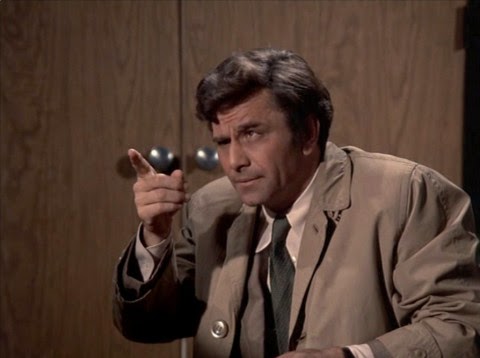
And do you know, I don’t think Mr. and Mrs. Bagnet are the only functional, healthy married couple in this story after all. Mr. and Mrs. Bucket are quite on the same level of marital success, by all appearances. Aside from the part where he shoves a sheet in her mouth so she won’t exclaim and then leaves it there for the entire conversation. But even that fits nicely with my image of Detective Bucket as Columbo.

The way he puts it to Mr. Smallweed (“Now, don’t open your mouth too wide, because you don’t look handsome when you do it”) and then makes Hortense link arms with him on the couch when she so clearly wants to rip his throat out with her teeth, and the way he is a blue-collar detective investigating the lives of the rich and powerful and saying things like, “I am damned if I am a-going to have my case spoilt, or interfered with, or anticipated by so much as half a second of time by any human being in creation.”

"When Mr. Bucket has a matter of this pressing interest
under his consideration, the fat forefinger seems to rise
to the dignity of a familiar demon."

At first, when Ada was being all gloomy around Esther, I was afraid that she had secretly gotten engaged to Woodcourt, which would absolutely break The Girl Code. But it’s all good because it turns out Ada just ran off and tied her tugboat to the Titanic. So phew.

But really, if Ada were a smart girl, she would be flouncing around Woodcourt and trawling for a proposal as though her life depended on it, Girl Code be damned. Because he saved shipwrecked people and doctored Jo and said this right to Vholes’s weasely, pale face:
“You seem to forget that I ask you to say nothing and have no interest in anything you say.”
Everybody else talk about how sweet and heartbreaking Sir Leicester’s reaction to the Awful Truth About His Wife was. I have some Gerard Butler Google image search results to attend to.

Tuesday, March 4, 2014

Bleak House Week 5: Romance and orphans are not welcome to sit at Dickens's table


Jumping right in on the subject of Esther and Jarndyce, in some ways, it seems right that she should marry him. She has been happy at Bleak House, he is a kind man, he does really seem to love her, and he has been her sole confidante in matters of her past. But . . . he's basically her father? Even though they aren't biologically related, there's a particular dynamic that's been set up here, and that dynamic is that HE'S HER FATHER.

Plus, as much as she loves him, she doesn't L-O-V-E him. She's talking herself into believing that she wants this match, but she's struggling with a mysterious sense of loss. And we know, even if she doesn't, that it's because her romantic affections lie elsewhere. But if you were to ask me where her affections lie, whether with Ada or with Woodcourt . . . I believe I would be forced to answer that they lie with both.

When Esther pulled out the dried flowers that Woodcourt left for her and that she saved all this time, she took them into Ada's room and touched them to her lips as she slept, and then she burned them over a candle. And in that one ritual, I think she said goodbye to Ada and Woodcourt together. Her chance at a sweeping, all-consuming romance existed with one of those two individuals, and now she has this instead:
I put my two arms round his neck and kissed him, and he said was this the mistress of Bleak House and I said yes; and it made no difference presently, and we all went out together, and I said nothing to my precious pet about it. 
It's just what every little girl dreams of.

And, because I can't resist gaying up Bleak House just a little more, I could be easily convinced that Woodcourt has more than a friendly interest in Richard. He met the shock of Esther's changed face with admirable composure, and really I don't think it bothered him much at all past the sadness he felt for her personal loss. But he was very bothered indeed by Richard's face.
Mr. Woodcourt had a perception that all was not going well with him. He frequently glanced at his face as if there were something in it that gave him pain, and more than once he looked towards me as though he sought to ascertain whether I knew what the truth was.
And then when Esther asked him to take Richard under his wing as a friend in London, he earnestly accepted this calling as a sacred trust. And, yeah, maybe he's throwing himself into this with such gusto because he loves Esther and wants to ease her worries in any little way he can, but isn't it funner if we look at it the other way?

Who do we think shot Skulkingscorn? I know we're supposed to believe it was Lady D, since she went for a "walk" in the "garden" that night. But it could be any number of people. George probably wouldn't kill him, but that impassioned speech in which he compared him to a rusty carbine and said he would take him down on a fair field, and then had to self-soothe by whistling the national anthem and rocking himself gently, will certainly make him a suspect.

My money, though, is on Hortense. She came to Tulkinghorn justifiably upset. He had coerced her into selling out her employer, and then she lost her placement. She may be a little unbalanced, but her request was reasonable. All she wanted was help finding another job. But could Tulkinghorn meet this logical request with a logical response?

Niiiiiice knowing you, buddy.

As for people who are wonderful and deserve to live forever, every single moment in Chapters 46 and 47 was both the best and the saddest moment in the whole book for me. I know that Woodcourt has done great things for the shipwrecked people of India, but when he chased Jo in a "grimly ridiculous pursuit" just because Jenny asked him to, and then made sure Jo was safe at George's and cared for him personally, that's the point when I thought, "This is the one man on Earth who actually deserves Esther."

And Phil took particular interest in Jo's care and then cried on his hammer when Jo's cart was getting its heaviest. . . probably because he saw himself in this grimy, dejected boy walking up against the buildings, touching every filthy brick as he went. And George opened his home to him for the same reason, I think. And Snagsby risked, not to put too fine a point on it, the wrath of his little woman to come visit Jo on his deathbed. And when even three half-crowns weren't enough to fix this problem, he vowed to record Jo's apology so that he would finally be able to access the secret power of the written word that had always been so far out of his reach. Snagsby helped Jo feel more human.

Basically, the image of this group of men finally filling the role of nurturer for a boy who has never known anything but moving on and moving on and forever moving on, that image did me right in.

And you know what else did me in?
He also descries promise in the figure of Mr. George himself, striding towards them in his morning exercise with his pipe in his mouth, no stock on, and his muscular arms, developed by broadsword and dumbbell, weightily asserting themselves through his light shirt-sleeves.

Tuesday, February 25, 2014

Bleak House Week 4: And the nominees are . . .


In this week’s section, every character seemed to reach a personal high of either awesomeness or asshattery. So let’s do this awards-season style and announce some nominations.

Most Romantic Couple

Esther Summerson and Allen Woodcourt: Allen isn’t technically in these chapters, but Miss Flite brings news of his heroic deeds following a shipwreck in the East Indian seas. Esther expresses some pretty intense feelings of admiration and love (YES, LOVE) after receiving these tidings, and then she writes the most quietly romantic and selfless tribute to her love-affair-that-could-have-been-but-she’s-grateful-never-was-because-of-her-face:
Oh, it was so much better as it was! With a great pang mercifully spared me, I could take back to my heart my childish prayer to be all he had so brightly shown himself; and there was nothing to be undone: no chain for me to break or for him to drag; and I could go, please God, my lowly way along the path of duty, and he could go his nobler way upon its broader road; and though we were apart upon the journey, I might aspire to meet him, unselfishly, innocently, better far than he had thought me when I found some favour in his eyes, at the journey’s end.
Esther Summerson and Ada Clare: After her illness had done its number on her face, Esther walked all around the village in Chesney Wold and talked to Charley and John Jarndyce with no more than a passing twinge of sadness about her diminished looks. But when the time finally came to reveal herself to Ada, she LOST it. Overcome with the anxiety of waiting idly, she set off up the road to meet Ada’s carriage, but then she panicked and ran all the way back home, impulsively hiding behind her bedroom door . . . and then Ada was there, and they ended up in a heap on Esther’s bedroom floor, with Ada embracing and rocking her and crying and kissing her scarred face.


Mr. and Mrs. Bagnet: These two are a TREAT. First, Mrs. Bagnet tells George exactly where he can go if he is even thinking of defaulting on that loan and screwing over her trusting husband. And then Mr. Bagnet, out of her hearing, describes her various virtues to George in such sincere and halting language that I’m convinced one would be quite wise in striving to achieve a relationship just like theirs, founded on even a fraction of their implicit trust and teamwork.

Best Comedic Duo

Mr. Smallweed and Judy: This is the only nominee . . . because there’s really no competition.
Here Mr. Smallweed, wrought up to the highest pitch by his own eloquence, actually throws Judy at her grandmother in default of anything else, by butting that young virgin at the old lady with such force as he can muster and then dropping into his chair in a heap.

Most Amusing Use of a Wall

I tell you, there's a Supernatural GIF for every occasion.

Phil Squod: “Phil approaches in his usual way, sidling off at first as if he were going anywhere else and then bearing down upon his commander like a bayonet-charge.”

Mr. Jellyby: “‘He comes every evening,’ returned Caddy, ‘and is so fond of sitting in the corner there that it’s a treat to see him.’ Looking at the corner, I plainly perceived the mark of Mr. Jellyby’s head against the wall.”

Most Pitiable Wretch

Lady Dedlock: This woman. She’s spent 20-something years believing that her sweet baby died. And then she hears that the daughter she thought was dead and just learned is alive is sick with a disease that will likely kill her. And after that danger passes, she gets just one meeting with her long-lost daughter to hug her and cry over her and drop her façade of cold indifference, before she has to go back to being the honorable Lady Dedlock and never a mother to Esther forevermore, lest she disgrace her faithful husband’s most honorable name.

Richard Carstone: It was a toss-up whether Richard belonged in this category or the one below, but in the end, I’m pretty convinced that Richard sincerely believes he’s doing the only thing he can do in pursuing Jarndyce and Jarndyce. We know he had a gambling problem before, and he is now exhibiting all the signs of an addict trying to justify the continued pursuit of his self-defeating behavior.
I am young and earnest, and energy and determination have done wonders many a time. Others have only half thrown themselves into it. I devote myself to it. I make it the object of my life.
We have something to tell you, Richard:
You are not special.

Miss Flite: We learned a little bit more about the frail little woman who haunts Chancery, and her story makes Jarndyce and Jarndyce sound more like a far-reaching curse than anything has yet. Her little family was perfectly fine until her father was drawn into the suit and died in a debtor’s prison, her brother was drawn into the suit and died a drunk, and her sister was drawn into the suit and apparently ended up doing something worse than both of those things because we're forbidden to speak of it. And now it’s Miss Flite’s turn, and who knows what her end might be, but it will likely involve dead birds in cages.

Most Shameful Excuse for a Man That Ever Was

William Guppy: This cowardly son of a baboon in ribbons. After prostrating himself before Esther in what he claimed was helpless love for her and complaining to anyone who would listen about how she broke his heart and he could never be happy again, all it takes to expose that as a damn-dirty lie is for Esther to lift her veil and show him her scarred face. He barely fell short of making her sign a statement confirming that there was never an official engagement between them and such an offer could never be renewed . . . because of reasons. But he is devoting himself to finding and destroying that packet of letters that would serve as solid evidence of Esther's parentage. Credit where credit is due.

Effing Harold Skimpole: It can be argued that Skimpole hit his all-time character low when he suggested that Esther and Jarndyce throw a critically ill Jo back into the cold, cruel world. His current damaging influence on Richard is much more subtle and all the more insidious for it. And as much as he claims to have no responsibility for anyone, least of all himself, Esther has straight-up told him, “Look. Richard is heading for ruin and you are helping him to his destination sooner. THIS IS ON YOU.” He can’t claim ignorance after having it told him so plainly, but he insists on enabling Richard’s doomed course. If he is, in fact, a child, he should be grounded indefinitely—in a prison.

So those are the nominations, and I'm not picking any winners.

Also, I may have found the official GIF of the Bleakalong.

Tuesday, February 18, 2014

Bleak House Week 3: I’m too upset to talk about Jo.


This week was basically commandeered by Mr. George. “Bah,” I hear you all saying. “Mr. George’s chapters are booooooring.” WRONG. No scene is boring when there’s a Mr. George in it. I'm entertained when he’s begging Esther “not to desert him” as Miss Flite tugs him away by the arm; when he’s reminiscing with Phil Squod about their meet-cute (“I remember, Phil. You were walking along in the sun.”); when he’s pulling the elder Smallweed up by his shirt and giving him a good jostle; when he’s waking Tulkinghorn up to tell him, no he won’t be participating in this shady business with Captain Hawdon’s letters, good DAY, sir.


And it seems Judy Smallweed also has a bit of a crush on George, and her grandfather embarrassed her by announcing that she couldn’t be kept away because she so longed to see him. But Smallweed broke the first rule of being a helpless old coot: Don't piss off the person on whom you depend to keep you upright in your chair.
Mr. George is quite confounded by the spectacle he beholds from time to time as he peeps into the cab through the window behind him, where the grim Judy is always motionless, and the old gentleman with his cap over one eye is always sliding off the seat into the straw and looking upward at him out of his other eye with a helpless expression of being jolted in the back.
I'm relieved that Caddy is successfully married and I can stop raging at Mrs. Jellyby to care about her daughter. But I worry about the children (even though Peepy is the only one worth mentioning, apparently), and Mr. Jellyby's mental health is in further danger now that Caddy is gone. Maybe he'll meet Phil Squod soon, and they can bond over their shared fondness for touching walls.

President and vice president of the
Wall Appreciation Society.

I know we all hate Guppy, but whatever else he is, the guy is a pretty good detective. While Tulkinghorn is still looking for a sample of Captain Hawdon’s writing, Guppy is in Lady D’s private chamber telling her how it is. And did it seem as though Lady D was proud of Esther when Guppy said she turned him down? If so, she felt a connection to Esther even before she knew Esther was her daughter. Perhaps because THEY HAVE THE SAME FACE. Even Mr. George noticed that, and he’s “one of the roughs.”

About Esther’s face. Alice and I talked a little yesterday about how Esther must be pretty, because everyone is always remarking on Lady D’s stunning beauty and we’re supposed to believe that Esther is the spitting image of her. But has anyone else been picturing Esther as sort of . . . plain this whole time? We obviously can’t trust her to provide an accurate description of herself, so we have to look at what other people say about her. And other people have been dropping hints that she’s quite as stunning as Ada. This could go along with the theory that Dickens wanted to improve on Jane Eyre. He may have thought that plainness and virtue shouldn’t go together and so made his heroine a virtuous beauty instead. And I guess now she’s blind? And all the more virtuous and beautiful for it, I’m sure.

My suspicions about Guppy and Jobling were correct. They are plotting to relieve Krook of the bundle of letters he took from Nemo/Hawdon’s bag. Which is why I don’t feel bad for Jobling when Snagsby wanders up and inadvertently freaks him the hell out.

It’s a wonder you can stand to sleep in the same room where that young man died so gruesomely. Let me tell you just how gruesome it was, since you were spared the sight of it. And isn’t it curious that he was living there and law-writing for me and now you’re living there and law-writing for me? It’s almost like a dark fate connects you to him. Well, anyway. SWEET DREAMS.

Tuesday, February 11, 2014

Bleak House Week 2: So far, this puzzle is mostly corner pieces.


We're not anywhere near getting a full picture at this point, but there have been definite developments.

Lady Dedlock continues to be a difficult woman to entertain. Most recently, she showed that she is also hilariously bad at undercover work (“I am but a lowly servant woman. DON’T TOUCH ME, PEASANT.”)

Richard has his hands full sorting out what he wants to be when he grows up.

We've ruled out priest and surgeon,
but little black rain cloud is still a viable option.

And what of our dear Esther? As practical as she is in the matters of the Jarndyce household and other people’s lives in general, she can’t seem to afford herself the same no-nonsense treatment everyone else gets. Guppy is stalking her. Brazenly. And yet she says, “It was at the theatre that I began to be made uncomfortable again by Mr. Guppy.” Never has there been a more telling use of passive voice. Repeat after me, Esther: Guppy is making me uncomfortable.

She still seems to be in love with Ada (“It was so pretty to have her clinging to me in that way . . . that I would not help her just yet”; “To see Ada lift up her flushed face in joyful surprise, and hold me round the neck, and laugh, and cry, and blush, was so pleasant!”), but now Mr. Woodcourt, the young dark surgeon (who I think is the same young dark surgeon present at Nemo’s death scene) has entered the picture. I'm not sure how Esther feels about him. She gets a bit squirrelly on the subject of Woodcourt, talking out of the corner of her mouth about his participation in the events of her narrative, if she talks about him at all.

Dickens is providing plenty of commentary on the disparity between the upper and lower classes, but along with that, he seems to be showing us that children are the most vulnerable casualties of this system, even below unattached women. Just look at Tom and Charley.
It was the first time since our entry that a tear had been shed among these children. The little orphan girl had spoken of their father and their mother as if all that sorrow were subdued by the necessity of taking courage, and by her childish importance in being able to work, and by her bustling busy way. But now, when Tom cried, although she sat quite tranquil, looking quietly at us, and did not by any movement disturb a hair of the head of either of her little charges, I saw two silent tears fall down her face.
Not crying. Not . . . crying.

And then there’s Jo, who is even more alone in the world than Tom and Charley, because he doesn’t have a Tom or a Charley. And he is further victimized by his keen awareness that society considers him more an animal than a human, and also that he quite agrees with that judgment in the end. But what can he do to improve his standing? Nothing whatsoever, because the system is stacked against him. Even when he’s given money—the great equalizer—the more powerful rob him of it in one way and another, and then nobody believes his story about how he obtained the little he has left. He cannot win.

In other developments . . .
  • My fondness for Boythorn grows, helped along by his outspoken distaste for one Harold Skimpole and one Harold Skimpole’s continued lack of principle, and sealed by his extreme commitment to this dispute with Sir Leicester. The man posted cheeky “No Trespassing” signs and set up an elaborate bell-and-bulldog attack plan. He’s my hero.
  • I think that Mrs. Chadband is Mrs. Rachael Chadband. This gives me hope that we may yet see her get her comeuppance for being an evil hag to little Esther. Regardless, she’s married to Mr. Chadband, so her suffering has just begun.
  • Guppy and Smallweed are up to no good. I don’t know exactly what they’re up to just yet, but they’ve put Mr. Jobling in Krook’s open room and connected him with work law-writing for Snagsby and introduced him to Krook by a made-up name (Mr. Weevle? At least let the man choose his own alias). It feels as though Nemo’s mysterious history may be repeating itself with a new mark. And Guppy may be even worse than he already seems.


We can ALL see your bad-guy costume under that top hat.

Tuesday, February 4, 2014

Bleak House Week 1: PHENOMENAL CHARACTER DEVELOPMENT. Itty-bitty plot line.


**Declaration of Intent to Readalong: This post is part of a group read of Bleak House, hosted by Alice at Reading Rambo. If you are not currently or have not previously read this book, the words that follow will make no sense to you. I'm not giving you a synopsis. I'm not your mother. Alternatively, you can join the readalong and then we all win.**

Somehow, in 166 pages of book and very little in the way of actual plot, Dickens has said so VERY much. And I have taken several pages of scribbly notes.

Hosted by Alice, not Cecil Baldwin.
Let’s talk about Esther first, just in case I run out of time and space and will to live before I get to anything else.

She had a rough go of it in the beginning, with that godmother who kept reminding her it would be better if she were never born. (“Your mother, Esther, is your disgrace, and you were hers. . . . I have forgiven her the wrong she did to me, and I say no more of it, though it was greater than you will ever know—than any one will ever know but I, the sufferer.” I do not think forgiveness means what you think it means, m'lady.)

As a result of which Esther’s only friend is her doll, and we are made very sad by this (especially when she inexplicably decides to bury her only friend in the garden-earth).

When her godmother dies, her situation immeasurably improves in the capable hands of her benefactor, one John Jarndyce. But the damage to her psyche seems pretty well done, because she insists on being persistently self-deprecating.

A sampling of scenarios in which I fantasize about giving Esther firm guidance:
  • Rachael, a servant who essentially watched Esther grow up, shows no emotion when Esther is about to leave, never to return. And Esther blames herself for not being a better little girl so that Rachael would love her more and thus be sad to see her go. “I felt so miserable and self-reproachful that I clung to her and told her it was my fault, I knew, that she could say good-bye so easily!” NO, ESTHER. Rachael is dead inside.
And this is how mean Rachaels
should be dealt with.
  •  Esther leaves the school where, for 6 quiet years, she has been teaching and learning and soaking up the never-before-experienced adoration and appreciation of others. And she cries about it. And she scolds herself for crying about it. LET YOURSELF CRY, ESTHER. Crying feels nice.
  • “I don’t know how it is that I seem to be always writing about myself. I mean all the time to write about other people, and I try to think about myself as little as possible, and I am sure, when I find myself coming into the story again, I am really vexed and say, ‘Dear, dear, you tiresome little creature, I wish you wouldn’t!’ but it is all of no use.” YOU ARE THE FIRST-PERSON NARRATOR, ESTHER. It's OK to first-person narrate.
  • When Harold Skimpole (effing Harold Skimpole) is ever so subtly asking Esther and Richard to pay his debt for him so he won't be carted away by the lawman: “It was a most singular thing that the arrest was our embarrassment and not Mr. Skimpole’s. He observed us with a genial interest, but there seemed, if I may venture on such a contradiction, nothing selfish in it. He had entirely washed his hands of the difficulty, and it had become ours.” BECAUSE HE IS PLAYING YOU LIKE A FIDDLE, ESTHER.
  • When she first meets Ada and Ada actually wants to talk to her: “What a load off my mind! It was so delightful to know that she could confide in me and like me! It was so good of her, and so encouraging to me!” MAYBE YOU ARE JUST A DESIRABLE CONVERSATIONAL PARTNER, ESTHER.

Speaking of Ada . . . we’re all in agreement that Esther is in love with her, yeah? Poor Richard. He and Walter Hartright from The Woman in White should form a support group for men who marry the women they love but also have to be OK with the women who also love their wives hanging around all the time. Because I get the sense that Richard and Ada will get married and Esther will go ahead and move in with them.

Or not? Depending on one's outlook.

There is TONS of subtext to support Esther's interest in Ada, but I’m relying on Alice to address it in depth, with evidence from scholarly sources. I will just say that when Esther is retelling the instance of her first meeting with Ada and Richard, it goes a little something like this:
There was a young lady whose hair shone like spun gold and the fire's glow fell upon her angelic face, which was innocent and trusting. And her blue eyes. OMG . . . her blue eyes. And she nestled with me in the window seat and captivated me completely, and I can’t believe my luck that she would deign to converse with such a lowly creature as I. And, oh yeah, Richard Carstone was there, too. He was handsome and nice.
And now a cursory discussion of Things That Are Not Esther.


This is the first Dickens I’ve read that was not one of those illustrated children’s editions (also how I read Moby Dick, which I realize possibly doesn’t count). So I’m realizing that he’s a ridiculously good writer? He knows how to use the words and put them together to make the nice sentences. I’m thoroughly impressed by the level of detail he packs into every page. And, yeah, not much of anything has really happened (there’s a never-ending lawsuit and Lady Dedlock recognized someone’s handwriting and was UPSET about it and a law-writer named Nemo has overdosed on opium the end), but his characters are an event in themselves.

There's Mrs. Jellyby and Mrs. Pardiggle (and their poor husbands and children—the Pardiggle children being much less sympathetic than the Jellyby children on the whole, I would say). And Harold Skimpole, who is essentially a freeloader who had a ton of children and then abandoned them and continues to get into debt and ask other people to get him out of it, but it’s OK because he’s no more than a child himself (NO IT IS NOT OK, although I do enjoy his opinions on bees).

And then there’s John Jarndyce, with his tendency to feel the effects of an east wind whenever someone brings up something he would rather not talk about. He seems perfectly lovely, but I’m not sure I agree with his being the source of Esther’s weirdly insulting nicknames (Old Woman, Little Old Woman, Cobweb, Mother Hubbard . . . the poor woman is, like, 20 years old and already has record-low self-esteem). And most recently, we met Mr. Boythorn, whom I’m inclined to like for many reasons, not least of which being his hilarious feud with Leicester Dedlock over who owns a dirt path. But that canary. The way he trained it and has it eating out of his hand . . . it reminds me of another large man who enjoyed tiny animals and ended up being the most dastardly of villains.

Remember Count Fosco and how he looked like this
when he was being a badger?

Sunday, April 1, 2012

The Woman in White Super-Happy-Fun-Time Read-Along begins...NOW


It's time for another Reading Rambo read-along!


We're reading The Woman in White, which I've been meaning to read for a while and is also one of the books in my Smooth Criminals reading challenge for this year. So far April is advertising itself as the month for conveniently overlapping goals, which automatically makes me suspicious. *looks askance at April*

I know almost nothing about this book, and this will be my first foray into Wilkie Collins's oeuvre. The author blurb in my Bantam Classic copy tells me that Wilkie and Charles Dickens were basically the Anne and Diana of 19th century London.
"Collins brought out the boyish, adventurous side of Dickens's character; the two novelists traveled to Italy, Switzerland, and France together, and their travels produced such lighthearted collaborations as 'The Lazy Tour of Two Idle Apprentices.' They also shared a passion for the theater, and Collins's melodramas . . . were presented by Dickens's private company, with Dickens and Collins in leading roles."
Just pretend these kindred spirits have beards.
BUT Charlie and Wilkie didn't stop at skipping across Europe and giggling over black currant wine; they were also bosom friends of douchebaggery and . . . well . . . of actual bosoms. We all know Dickens was an ass hat, and Wilkie had two mistresses that he didn't even bother to keep secret. He even fathered three kids with one of them (that lucky lady).

The good news is, he was afflicted with a horribly painful eye disease and died. So it seems as though it all came out fair and square at the last.

Now, let's make with the read-alonging!